
By John Gordon, in partnership with Uncertainty Experts
The presentation happened. Heads nodded. Someone said "we should really get ahead of this." A working group formed. Terms of reference were drafted.
That was six months ago. What has actually changed?
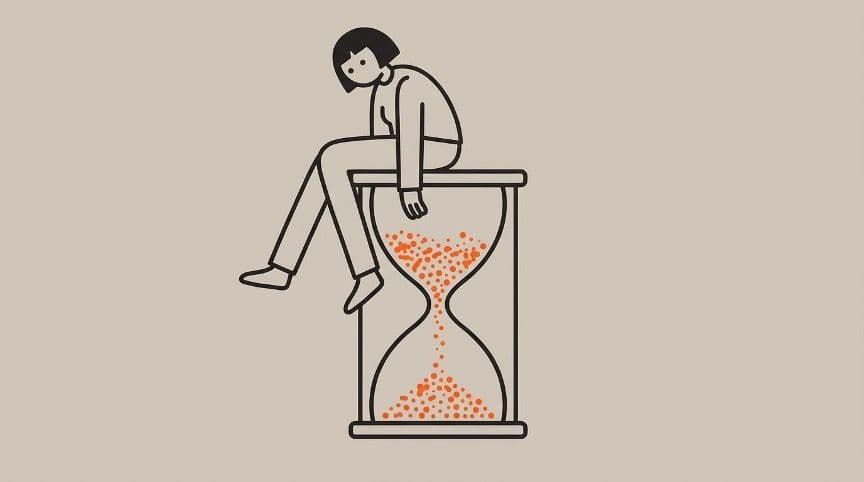
If the answer is "not much," your team is in Stasis. Of the three states identified through Uncertainty Experts' research with UCL, this one costs the most. Article 3 covered Fear: the state that blocks teams from starting. Article 4 covered Fog: the state that disguises evaluation as progress. Stasis is different. There is no trigger that forces a team out of it. The absence of crisis feels like stability. It is not.
The gap that compounds
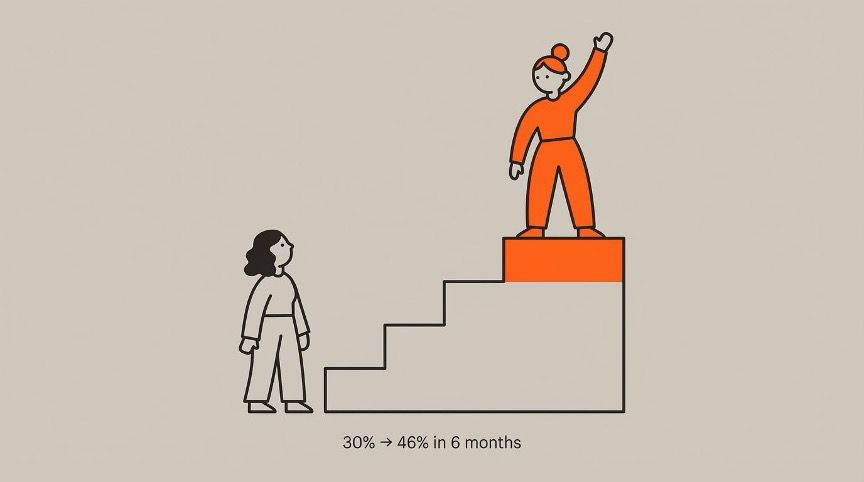
The WEF projects 39% of skills obsolete by 2030. That is 48 months away. McKinsey reports nearly a third of organisations expecting workforce reductions of 3% or more. Not discussing. Planning. Stanford researchers documented a 13% decline in entry-level hiring in AI-exposed roles. The bottom rungs of the career ladder are being removed while your team waits for a clearer signal.
The Federal Reserve measured adoption jumping from 30% to 46% in six months. The competitive gap compounds. The organisation that started six months ago is not six months ahead. It is six months of compound learning ahead. Each month the gap widens faster.
Jensen Huang's observation applies to organisations as much as individuals: you will not lose market position to AI, but to competitors whose people use AI. PwC's 25% wage premium means organisations without programmes lose their best people to organisations that have them. The talent drain is quiet. Nobody announces they are leaving because the organisation lacks an AI capability programme. They just leave.
HBR and UC Berkeley researchers found 62% of entry-level AI adopters report burnout. That sounds like a reason to wait. It is the opposite. The burnout comes from unstructured adoption: people thrown at tools without skills, without frameworks, without support. Structured capability building produces the opposite effect. It reduces the production workload and increases the time available for strategic work.
The AI washing trap
Yale Budget Lab found no significant displacement yet. Altman warned "AI washing is real." These are legitimate findings. Some companies are relabelling existing products. Some are cutting headcount for unrelated reasons and calling it AI transformation.
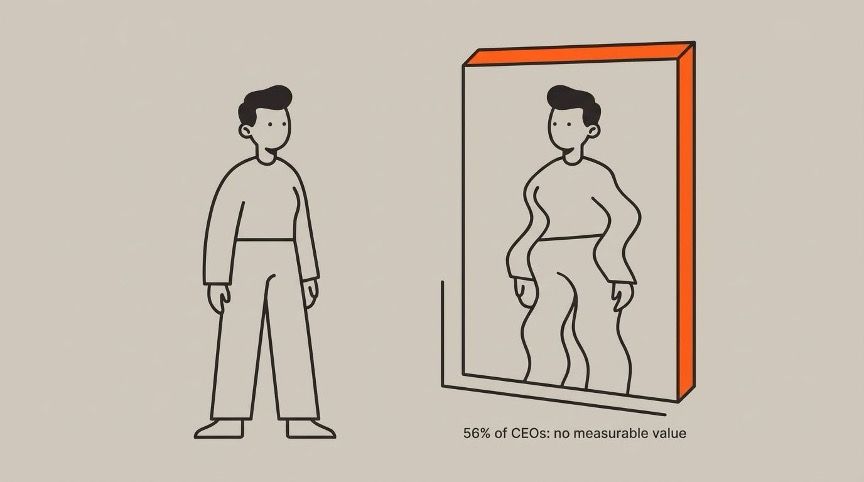
But AI washing is real AND the transformation is real. Both, simultaneously. PwC's Global CEO Survey found 56% of CEOs report no measurable value from AI investments. The NBER found 89% of firms report no productivity impact. These are not organisations that ignored AI. They invested. They bought tools. They never built the capability to use them.
The danger for teams in Stasis is confirmation bias. "See, even the experts say it is overhyped" becomes permission to wait. But the contrarian data does not say AI is not changing work. It says organisations are failing to capture value without structured capability building. The skills still matter. The gap still compounds.
Why Stasis is so persistent
Conviction Narrative Theory, developed by Johnson, Bilovich, and Tuckett at UCL and published in Behavioral and Brain Sciences, explains the mechanism. The brain does not distinguish, emotionally, between a memory and an imagined future. Teams in Stasis are experiencing imagined failure as though it has already occurred.
Imagine your team six months from now, having done nothing. A competitor publishes a case study showing 1.5 days saved per person per week. Your board asks what you have been doing.
Now imagine the alternative: ten delegates with demonstrable AI skills, mapped to SFIA 9, measurable hours recovered. The emotional difference between those two futures is real. The brain processed both scenarios as though they already happened. That is Conviction Narrative Theory in practice.
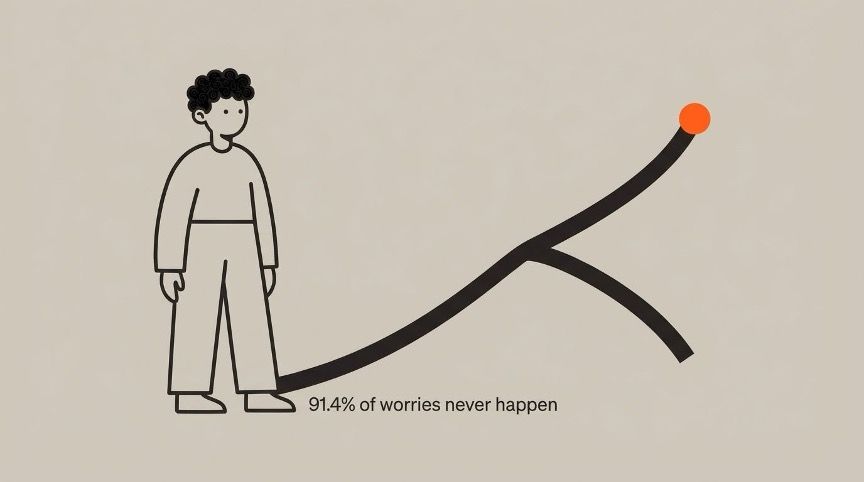
Research by LaFreniere and Newman, published in Behavior Therapy, found that 91.4% of worry predictions proved untrue. The catastrophic failure your team is planning for almost certainly will not happen. What will happen is that the gap keeps widening.
The cost of doing nothing
We see between one and two days saved per person per week in our AI capability programmes. That is 8 to 16 hours, based on internal results.
Take the conservative middle: 12 hours per person per week. A cohort of 10 delegates over 26 weeks: 10 x 12 x 26 = 3,120 hours of productive capacity sitting unused. Not theoretical hours. Hours your team could have spent on strategic work instead of production tasks.
The Capability Programme costs £150,000 per cohort of 10 to 12 delegates over three to six months. Against 3,120 hours, the cost per hour is approximately £48. Each delegate influences roughly five colleagues. Over six months, 10 delegates create measurable change across 50+ people.
Month seven of Stasis is more expensive than month one. The gap is wider, the talent more restless, the board less patient. Waiting does not reduce the cost. It increases it.
Article 6 describes the structural answer: not another pilot, not another strategy document, but a framework that resolves all three states and builds measurable capability your board can see.
The Finer Vision AI Maturity Assessment is free and takes 10 minutes.
It tells you where your team sits and whether you are ready for a structured programme or need a different starting point.
Take the free AI Maturity Assessment at finervision.com/assessment
References
1. World Economic Forum (January 2025). Future of Jobs Report 2025. 39% of skills obsolete by 2030.
2. McKinsey (November 2025). State of AI survey. Nearly a third expect 3%+ workforce reduction.
3. Brynjolfsson et al. (August 2025). Stanford / ADP payroll data. 13% entry-level hiring decline.
4. Federal Reserve Vice Chair Jefferson (November 2025). AI adoption. 30% to 46%.
5. Huang, J. (May 2025). Milken Institute. "Lose your job to someone who uses AI."
6. PwC / Burning Glass Institute. Global AI Jobs Barometer. 25% wage premium.
7. Yale Budget Lab (October 2025). No significant displacement yet.
8. Altman, S. (February 2026). India AI Impact Summit. "AI washing is real."
9. PwC (January 2026). 29th Global CEO Survey. 56% of CEOs no measurable value from AI.
10. National Bureau of Economic Research (February 2026). "Firm Data on AI" (w34836). 89% report no productivity impact.
11. Johnson, H., Bilovich, A., Tuckett, D. (2022). Conviction Narrative Theory. Behavioral and Brain Sciences, Cambridge University Press.
12. LaFreniere, L., Newman, M. (2019). 91.4% of worry predictions proved untrue. Behavior Therapy.
13. HBR / UC Berkeley (February 2026). "AI Doesn't Reduce Work." 62% entry-level burnout.
14. Finer Vision internal results. 1-2 days (8-16 hours) saved per person per week.
15. Uncertainty Experts / UCL. Fear, Fog, Stasis behavioural patterns.